


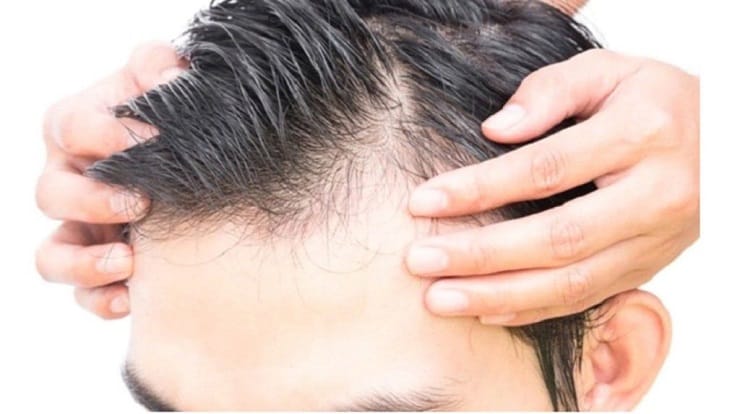
The capillary micrograft or also called follicular microtransplantation, consists of transplanting the hair from the back of the head and from the sides, areas in which genetics does not act, to areas with scarcity or affected by alopecia.
In this way, in the FUSS technique, the hair from the donor area is extracted through a thin band of skin with hair between 15 and 20 cm long and approximately 1 cm wide, which is obtained from the back or side of the head. with subsequent suture. As a result, a scar remains that is aesthetically imperceptible as long as the surrounding hair has a minimum length of 0.5-1 cm.
The FUE technique is a surgical variant of the follicular micro-transplantation technique and is considered the most advanced hair transplant technique that exists. It consists of individually extracting the follicles from the donor area without the need for stitches and without leaving linear scars.
Regarding the steps of the hair transplant intervention, we differentiate three mainly:
- Extraction of follicles from the donor area
- One or one separation and preparation of the hair follicles.
- Implantation of the follicles in the bald area
The most used implantation techniques are:
1. Hair implantation with the DHI technique: The acronym DHI responds to the translation of Direct Hair Implantation and consists of the automatic extraction and implantation in the hair transplant area, which is done individually, follicle by follicle. With it, a higher speed is achieved in the implantation of the hair, thus substantially reducing the time of the graft. It is a technique that allows the surgeon greater flexibility when implanting and places less stress on the follicle when handling it.
The DHI technique is carried out with a high-precision instrument known as an “implanter or implanter” that looks similar to a pen that has a tip at its end where the follicle is placed and implanted directly into the scalp. This is an instrument that allows you to accurately position the angle and position of the implanted hair.
2. Hair implantation with sapphire FUE technique: FUE performed with sapphire blades is not a technique in itself, but rather an innovation that constitutes a new advance within the FUE method. The method was sapphire, which is done using blades made from a precious stone called sapphire, it is defined as the use of special sapphire blades instead of steel blades during the process of opening microchannels in the receiving area.
What is the best technique?
All techniques are favorable, since the key is not in the technique itself but in the condition of each patient, which must be studied individually and treated with the most appropriate technique.
Once the complete study is done, the most appropriate technique will be recommended and the patient will be explained how the procedure will be carried out, the necessary sessions and the results to be expected.
Difference between both techniques:
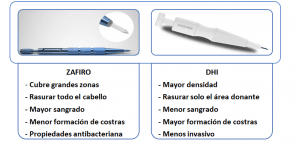
- The FUE method using sapphire blades is ideal for covering large areas, while the DHI method offers a better chance of achieving a greater ability to graft follicles between existing hair and thus be able to achieve higher density.
- The FUE method requires patients to completely shave their hair prior to the procedure, while the DHI method allows for the ability to shave just the donor area.
- The DHI method is less invasive because it is not necessary to open the channels (incisions) to implant the follicular units extracted from the patient’s donor area.
- Sapphire blades are incredibly precise in design, and their antibacterial properties reduce the risk of complications or tissue damage.
- The DHI method is usually cleaner due to less bleeding in the recipient area, which facilitates the formation of smaller scabs compared to other methods.
- With sapphire blades, the opening of the channels is done with the same length as the hair follicles, therefore, it is less possible for the follicles to move from their new location and their angular alignment cannot be altered after the intervention.
Author: Omarlys Pérez
Medical surgeon


